

DaVinci Resolve · Import, export and hand-off
How to import an EDL into DaVinci Resolve
The short answer
Add the source media to the Media Pool first, then choose File > Import > Timeline (Shift+Cmd+I or Shift+Ctrl+I) and select the .edl. Resolve matches each event to a Media Pool clip by reel name and timecode and builds the timeline.
5 steps
In DaVinci Resolve
- 01Import the media first
- 02Set the frame rate
- 03Import the EDL
- 04Check reel matching
- 05Or conform a flattened file
01
Import the media first
An EDL holds no media links. On the Media page, add every source clip the EDL refers to into the Media Pool.
02
Set the frame rate
Set the project's timeline frame rate to the EDL's frame rate before you import.
03
Import the EDL
Choose File > Import > Timeline and select the .edl file. In the import window, confirm the timeline name and frame rate and click OK.
04
Check reel matching
If events come in offline, the reel names in the EDL don't match the clips. Check how Resolve reads reel names in Project Settings > General Options > Conform Options, then import again.
05
Or conform a flattened file
If you have one rendered master and its EDL, use Resolve's pre-conform EDL option, which cuts the master at each event so you can grade it shot by shot.
Good to know
Before you start
- Note 1
- An EDL carries one video track and a limited amount of audio, cuts and dissolves. Effects, titles and multiple video layers don't survive.
Eddie AI
Do it in Eddie
Eddie doesn't read EDLs. To start a cut in Eddie, bring in the footage itself.
In the Eddie desktop app, import the clips from your Resolve project through the Resolve script, then ask for the edit you want, such as the selects from each interview in order. A Resolve timeline can come in too, as one piece of footage. The finished edit goes back to Resolve as a project, so there's no EDL in between.
Back to Resolve
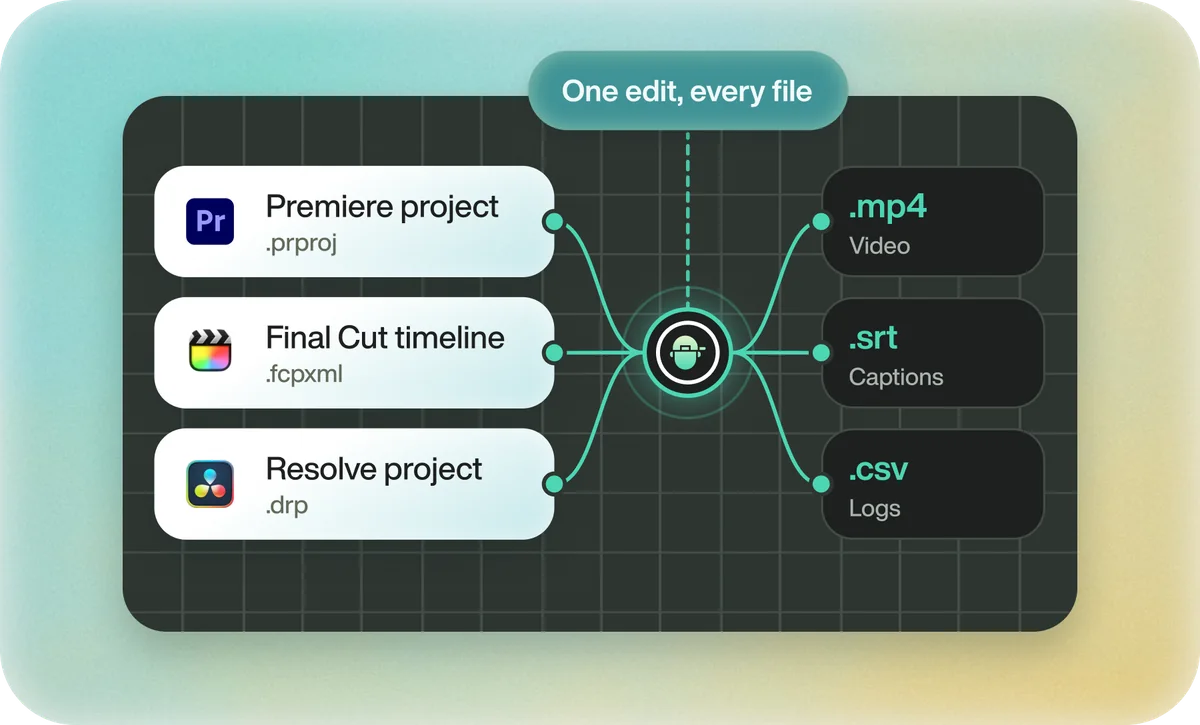
Open the edit, click Export and choose Resolve. The default is a Resolve project (.drp) that opens with the timeline built; behind the arrow is a Resolve FCPXML you bring into the project you have open with File > Import > Timeline. In the desktop app, Send to DaVinci Resolve builds the timeline in the Resolve you have running, through Eddie's script (Workspace > Scripts > Eddie AI AE).
If you imported the footage through the desktop app, the timeline points at your original camera files. If you uploaded on the web or pulled from cloud storage, it points at Eddie's proxy media: relink to those in the Media Pool with Relink Selected Clips, not to the camera originals.
FAQ
Questions
- Why are all my clips offline after importing an EDL?
- Resolve couldn't match the EDL's reel names or timecode to clips in the Media Pool. Import the media first and check the reel name settings in Conform Options.
- Does an EDL keep effects and titles?
- No. An EDL carries cuts, dissolves and timecode. Use XML, AAF or OTIO for more.