

DaVinci Resolve · Cutting and the timeline
How to remove silence in DaVinci Resolve
The short answer
In DaVinci Resolve Studio, transcribe the clip (right-click it in the Media Pool and choose Audio Transcription > Transcribe), then use the transcription window's option to remove silent portions. In the free version there is no automatic option: find pauses on the waveform, blade them out and ripple delete.

6 steps
In DaVinci Resolve
- 01Transcribe the clip (Studio)
- 02Remove silent portions (Studio)
- 03Build the trimmed version
- 04Free version: find pauses by eye
- 05Free version: cut them out
- 06Play it back
01
Transcribe the clip (Studio)
In the Media Pool, right-click the clip and choose Audio Transcription > Transcribe. Resolve opens the transcription window when it's done.
02
Remove silent portions (Studio)
Open the options menu (the three dots) in the transcription window and choose the option to remove silent portions. Resolve marks the silences in the transcript.
03
Build the trimmed version
Select the text you want and insert or append it to the timeline from the transcription window. Resolve leaves out the silent sections.
04
Free version: find pauses by eye
Make the audio track taller so the waveform is easy to read, and look for the flat sections between phrases.
05
Free version: cut them out
Blade (B) at each end of a pause, select it and press Shift+Delete (Mac) or Shift+Backspace (Windows) to ripple delete it.
06
Play it back
Removing every pause can make speech sound rushed. Leave short breaths and a beat after key lines.
Good to know
Before you start
- Note 1
- Automatic silence tools are Studio features and have changed across versions 19, 20 and 21. Recent Studio versions also have an AI silence tool on the Fairlight page that works on the audio and can leave gaps rather than close them, so check what your version offers.
- Note 2
- Remove silences before you lay b-roll. Ripple deletes move everything after them.
Eddie AI
Do it in Eddie
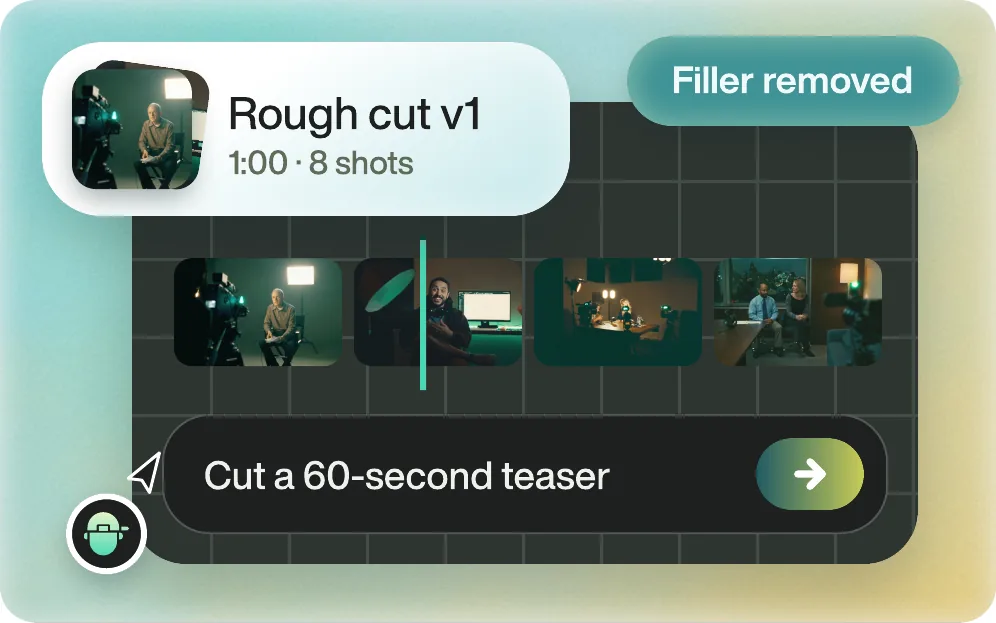
Eddie removes silences when you ask, and lets you say which pauses to keep.
Ask "Cut the long pauses" or "Leave a beat after the punchline." Eddie finds pauses from the transcript's timing, so it never mistakes quiet speech for a gap. Pauses show on the timeline as teal pause segments, you can ask Eddie to bring one back, and the pause timing carries through to the Resolve export.
Back to Resolve
Open the edit, click Export and choose Resolve. The default is a Resolve project (.drp) that opens with the timeline built; behind the arrow is a Resolve FCPXML you bring into the project you have open with File > Import > Timeline. In the desktop app, Send to DaVinci Resolve builds the timeline in the Resolve you have running, through Eddie's script (Workspace > Scripts > Eddie AI AE).
If you imported the footage through the desktop app, the timeline points at your original camera files. If you uploaded on the web or pulled from cloud storage, it points at Eddie's proxy media: relink to those in the Media Pool with Relink Selected Clips, not to the camera originals.
FAQ
Questions
- Does the free DaVinci Resolve remove silence automatically?
- Not as a one-click tool. The automatic options are tied to Studio's transcription and AI audio features; in the free version you cut pauses by hand.
- Will removing silence break my b-roll?
- Ripple deletes move everything after them, so b-roll on upper tracks can drift out of place. Remove silences first, then add b-roll.