A British voice actor, singer, and writer who spent a career behind the microphone, and then, for the first time, sat down in the editor's chair.
For most of her working life, Nicky Baker has been a voice without a face. If you have driven a car with a Parrot hands-free system, you may have taken directions from her: by her own account she is "the British voice" of the device. Across twenty-two years in Paris and the years since in the USA, she built a career almost entirely out of sound, more than seventeen years of it in audiovisual production, the kind of work that reaches millions of people who never learn the name of the person making it.
The range is the striking part. She has voiced animated characters since the late 1990s, with credits on series including Tara Duncan and Street Football, and done character dubbing for films, her own site connecting that work to directors as different as Roman Polanski and Luc Besson. Her commercial reel runs through nearly every category a brand can buy, beauty and cosmetics, hair care, fashion and perfume, automobile and travel, alongside audiobooks, corporate films, e-learning, and public service announcements. And she does the painstaking craft underneath a lot of dubbed television: dialogue adaptation, rewriting a cartoon's lines so they land on the English lip-sync, then delivering them in American, Australian, Scottish, Irish, Welsh, German, and a stack of other accents on request, in English, French, or Spanish.
Then there is the music, which is no sideline. Nicky Baker is a working recording artist with her own catalogue, songs like "At Least," "Greener," and "Could it be the Irish in me?," out on the usual streaming platforms under her name. She has written for other people too, and the names are real: songs for the Grammy-winning Beninese star Angelique Kidjo, for David Charvet, and for WhatFor, a band assembled on French television and produced by Universal. By her own count her songs had sold around 750,000 copies internationally by 2013, and one of them, "At Least," became the theme of a long-running Paris play. She writes the lyrics, sings the lines, and, in her home studio, records and directs herself.
What ties it together is not a single job title. It is a way of working that she has repeated her whole career: walk up to an unfamiliar medium, figure out how it wants to be spoken, and make it your own. She has done it with accents, with songs, with scripts. The one room she had never walked into was the edit.
The writer in the editing room
That changed on a documentary for Innit Productions. Nicky came onto the project as a writer. It was a job that should have stayed on her side of the glass. She wrote, and someone else, someone who had opened Premiere ten thousand times, would turn the footage into a film.
Except the job did not pencil out. The shoot ran eight days and produced two full episodes on a budget that never scaled to the footage. Eckelberry, who could see the math, said it plainly: how was he going to get through eight days of footage and two episodes without ending up paying to work?
The handoff
His answer became her turning point. To dig out of the A-roll, the hours of interview footage that had to be cut down before any story could begin, Eckelberry started running the interviews through Eddie, an AI assistant editor, and working from what came back. Not a finished cut. A starting point to react to. Eddie did the assistant editor's job, the ingest, the organizing, the logging, the syncing, and a rough assembly, so the human could take over for the part that actually needed a human.
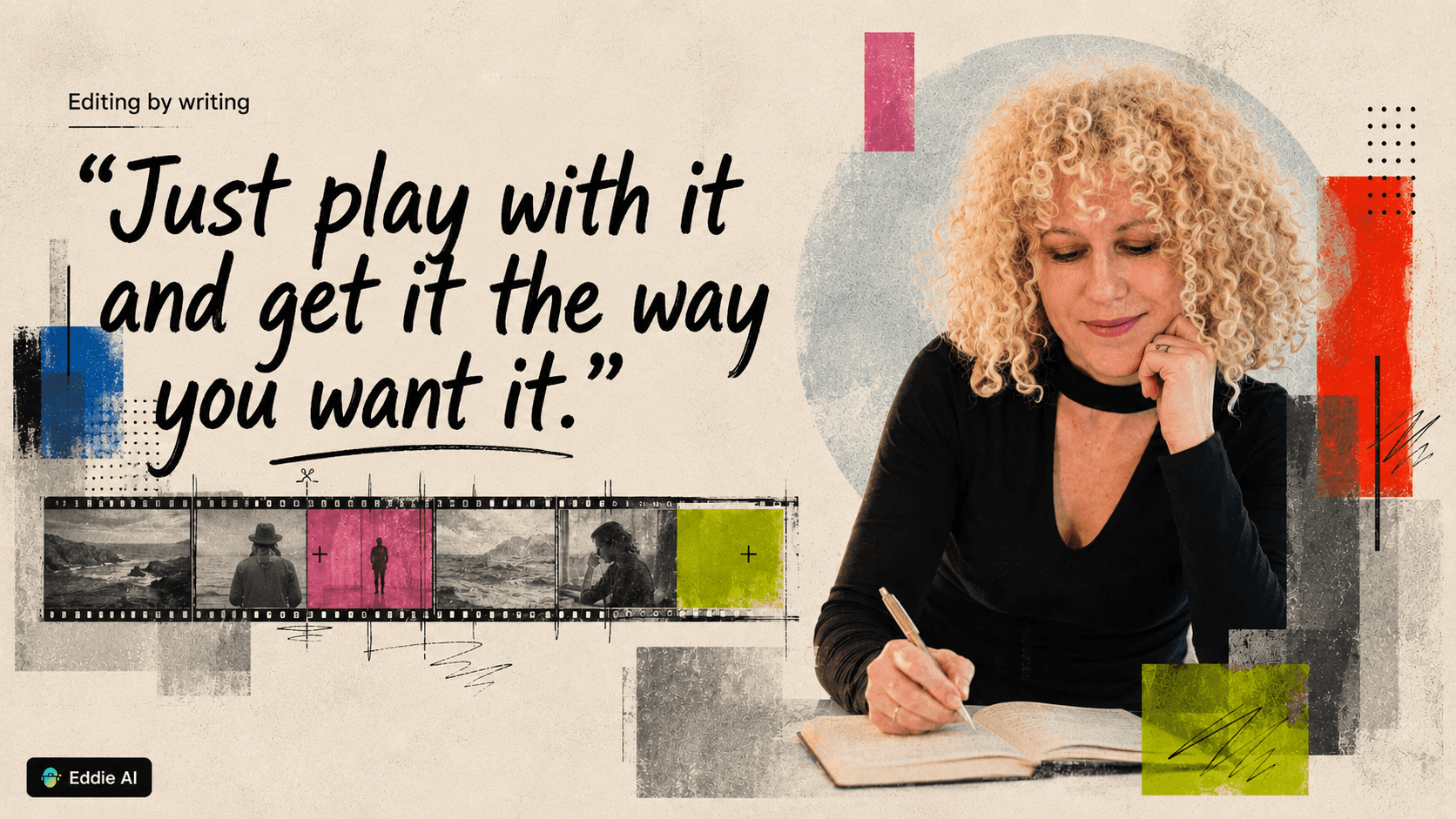
Then he did something braver. For the second episode, he handed Eddie to Nicky, the writer who had never opened Premiere, and told her: "Just play with it and get it the way you want it."
So she did. The same instinct that had carried her through accents and songs and scripts carried her here. The tool laid down an organized, edit-ready starting point, and she shaped it. Episode two got cut. Two episodes came out of eight days of footage, a budget that started impossible was delivered on time, and the storytelling stayed intact, which Eckelberry is the first to say is the part no software can do. In his words, it does not do the storytelling for you. It just gets you started.
A new way to be heard
There is a neat symmetry to it. A woman who spent decades giving other people's words a voice sat down and gave a story a shape, in a medium she had never touched, and it held. The barrier that usually keeps writers out of the edit, the years it takes to get fluent in the software, was suddenly low enough to step over. It is, in a way, the most natural move of her career. The microphone, the recording booth, the songwriter's desk, and now the timeline: different tools, same person, still doing the only thing she has ever really done, taking something raw and making it sound, or in this case look, like it was always meant to be that way.
About
Nicky Baker is a British voice actor, singer, songwriter, and writer with more than seventeen years in audiovisual production. European by background, she currently resides in the USA after twenty-two years working in Paris. Her voice-acting credits include the animated series Tara Duncan and Street Football, and she is a recording artist with her own released catalogue, alongside songwriting for artists including Angelique Kidjo, David Charvet, and the Universal-produced group WhatFor. By her own account her voice work also includes the Parrot hands-free GPS system and character dubbing on films connected to Roman Polanski and Luc Besson. On a documentary for Innit Productions she served as writer and, using the AI assistant editor Eddie, cut one of its two episodes despite having never edited before.