The Grammy-nominated producer behind #1 records turns the camera on his 85-year-old father, and finds himself tracing the source of his own music.
The details arrived the way they do in a long interview, one at a time, until they stopped sounding like facts and started sounding like a life. A boy growing up without shoes. A school held under a tree. Livestock to care for before the day could be his. A household built around faith. Kendrick Dean had heard pieces of his father's story for years. Hearing them now, on camera, with the man in front of him turning 85, was different.
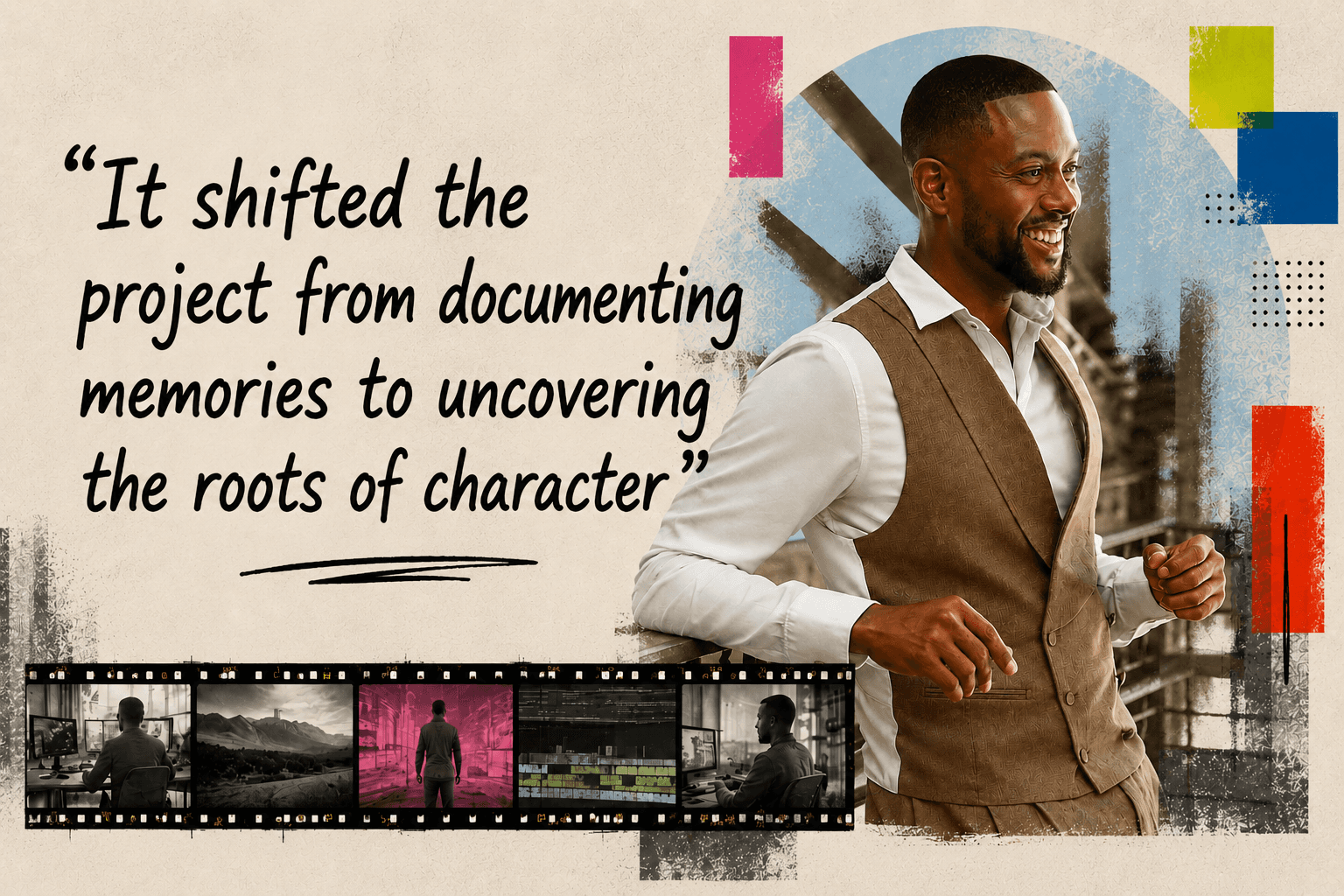
"What surprised me most wasn't a single story," he says. "It was realizing how many of the values I grew up with had very specific origins in his childhood." As his father talked, Kendrick saw the line running straight from a barefoot boy on a small Bahamian island to the man who raised him. "I wasn't just learning new facts. I was beginning to understand the origins of the values that shaped my own childhood." Somewhere in there, the film changed under him. "It shifted the project from documenting memories to uncovering the roots of character."
The man behind the camera
In another life, and under another name, Kendrick is Wyldcard, one of the producers and songwriters behind a long stretch of 2000s radio: Chris Brown's "Say Goodbye" and Mariah Carey's "I Stay In Love," both Billboard number ones, work for Trey Songz, Usher, Mary J. Blige, Monica, and Tyrese, and a hand in six Grammy-nominated albums. He broke in in 2004 on Destiny's Child's final album and built his own shop, The Dean's List Inc.
The ear that made those records was trained in the same household he is now filming: a South Florida home, drums and piano from a young age, a mother who sang and a father who ran a school by day and directed a church band. That classical, jazz, and gospel air is what the hitmaker eventually breathed back out into pop.
Why now
His father turns 85 this year. "Like a lot of families, we've heard pieces of his story over the years," Kendrick says, "but I realized there was an opportunity, and a responsibility, to preserve those stories while he's still here to tell them himself." That word, responsibility, sits under the whole project, and under it a clock.
Discovery, not cutting
So he built it to hold as much as it could: long-form sit-down interviews with both of his parents, each running well over an hour, captured on two cameras, alongside archival photographs, family materials, and newly filmed B-roll. The result is the documentary maker's familiar abundance and familiar problem: dozens of meaningful stories, all true, all competing for space in one film.
Ask him where the work gets hard and he does not say the cutting. "The hardest part isn't cutting footage," he says. "It's deciding what deserves to survive the cut." For a man who has spent his career deciding which take makes the record, the instinct is familiar ground. "Documentary filmmaking is really an act of discovery. Before you can think about pacing or visuals, you first have to discover the story's emotional spine buried within hours of conversation."
Room to explore
That search is where Kendrick brought in Eddie, an AI assistant editor. Before Final Cut Pro, he uses it to log the interviews, organize themes, generate different story structures, and build several first-pass assemblies he can react to. What he did not expect was its character. "Eddie feels less like a one-shot generative AI tool and more like an iterative editorial collaborator," he says: it kept reshaping the edit as he refined his prompts, remembering the context of earlier conversations. "That's not just generative AI. It's iterative editing."
It touches the stage that used to cost him days of watching interviews, dropping markers, and trying one structure then another. "Instead of starting with a blank timeline, I start with several thoughtful assemblies that I can compare, critique, and refine." The point was never speed. "Its biggest contribution isn't simply helping me edit faster. It's making editorial exploration much easier." Once the structure is strong he moves into Final Cut Pro for the rest, the pacing, the music, the color and sound, where the choices stay his.
What he is really after
The producer who spent a career chasing the right sound is, this time, chasing where his own came from. His father carried an island's lessons across an ocean and built a household that shaped a family and, eventually, a catalog of hit records. Kendrick is following that line back to its source, one interview at a time. "Exploration isn't wasted time," he says. "It's how you discover the story." It is also how a son discovers his father, and himself, while there is still time to ask.
About
Kendrick Dean (Kendrick Jevon Dean), known as Wyldcard, is a Grammy-nominated record producer and songwriter and the founder of The Dean's List Inc. Since 2004 he has produced or written for Destiny's Child, Chris Brown, Mariah Carey, Trey Songz, Usher, Mary J. Blige, Monica, and Tyrese, with #1 singles in Chris Brown's "Say Goodbye" and Mariah Carey's "I Stay In Love." The Man the Island Made is his documentary about his father, who grew up on Long Island in the Bahamas before immigrating to the United States. See his Wikipedia profile.