A Portland filmmaker who keeps the lights on with conservation videos and pours himself into documentaries about what gets carried forward, and the patient work of finding one spine inside a story with too many.
Most weeks, Jesús Contreras is making the kind of video nobody calls art. A public service announcement, a crowdfunding pitch, a clean and useful film for a government agency or a non-profit. His company, Wachanos Media, has cut work for the City of Portland's environmental bureau and a local soil and water conservation district, the civic storytelling that keeps a small production house running between Portland and Los Angeles. It is good work, and it is not the work that keeps him up at night.
That work has its own name. Under Wachanos Films, the art arm of the same shop, he makes short documentaries that travel festivals around the country, where the conservation-video craftsman becomes something closer to an author. It is where you find the film he is proudest of, a short with a title that doubles as a thesis: Javelina: Ingredients of Return.
The film follows Alexa Numkena-Anderson, the Indigenous chef behind Javelina, the Portland kitchen that reworks Native foods into something like fine dining and reframes the dark history trailing a dish like fry bread. On paper it is a film about food. Contreras does not see it that way. "It is about what food carries and what it can help restore," he says. The title came from a single idea, that return is made of real things: ingredients, relationships, labor, culture, place. He is not interested in food as spectacle, but in what a plate of it can hold. There is a quiet rhyme in it, too: the man who spends his commercial hours on soil, water, and conservation turns his own films toward land, food, and restoration.
The story with too many threads
The trouble with a story like Javelina is that everything wants in. The footage was interview-driven, layered with observational shots of food, of ingredients, of people and the places they work, and every layer pulled in its own direction at once: Alexa's personal journey, the cultural weight underneath it, her collaborators, the history, the emotion. A lesser editor lets all of it through and ends up with a film about everything, which is a film about nothing.
Contreras knows the trap, and he names it plainly. "The challenge," he says, "is finding the spine of the story without making it too broad." That is the through-line of how he works. Not the shooting, not the gear, but the slow discipline of deciding what a film is actually about, and then having the nerve to leave the rest on the floor. It is unglamorous and it is the whole job. A documentary lives or dies in the edit, in the hours nobody sees, where a sprawling pile of true moments either finds a shape or does not.
Where the work begins
That pile is also where the days disappear. Before any of the storytelling can begin, the footage has to be dealt with: hours of interviews logged, reviewed, and combed for the few minutes that matter. On a project as layered as Javelina, that grind threatened to eat the front of the schedule whole.
So Contreras brought in Eddie, an AI assistant editor, early, before moving fully into his own timeline. He used it to log the interviews, surface the strong moments, and start seeing the threads. "It helps me get closer to a first assembly faster," he says, "but I still make the creative decisions." For a film this dense, he estimates it saved him twenty to thirty hours in the early editorial stage alone. The number matters less to him than the feeling: "It makes the material feel less overwhelming."
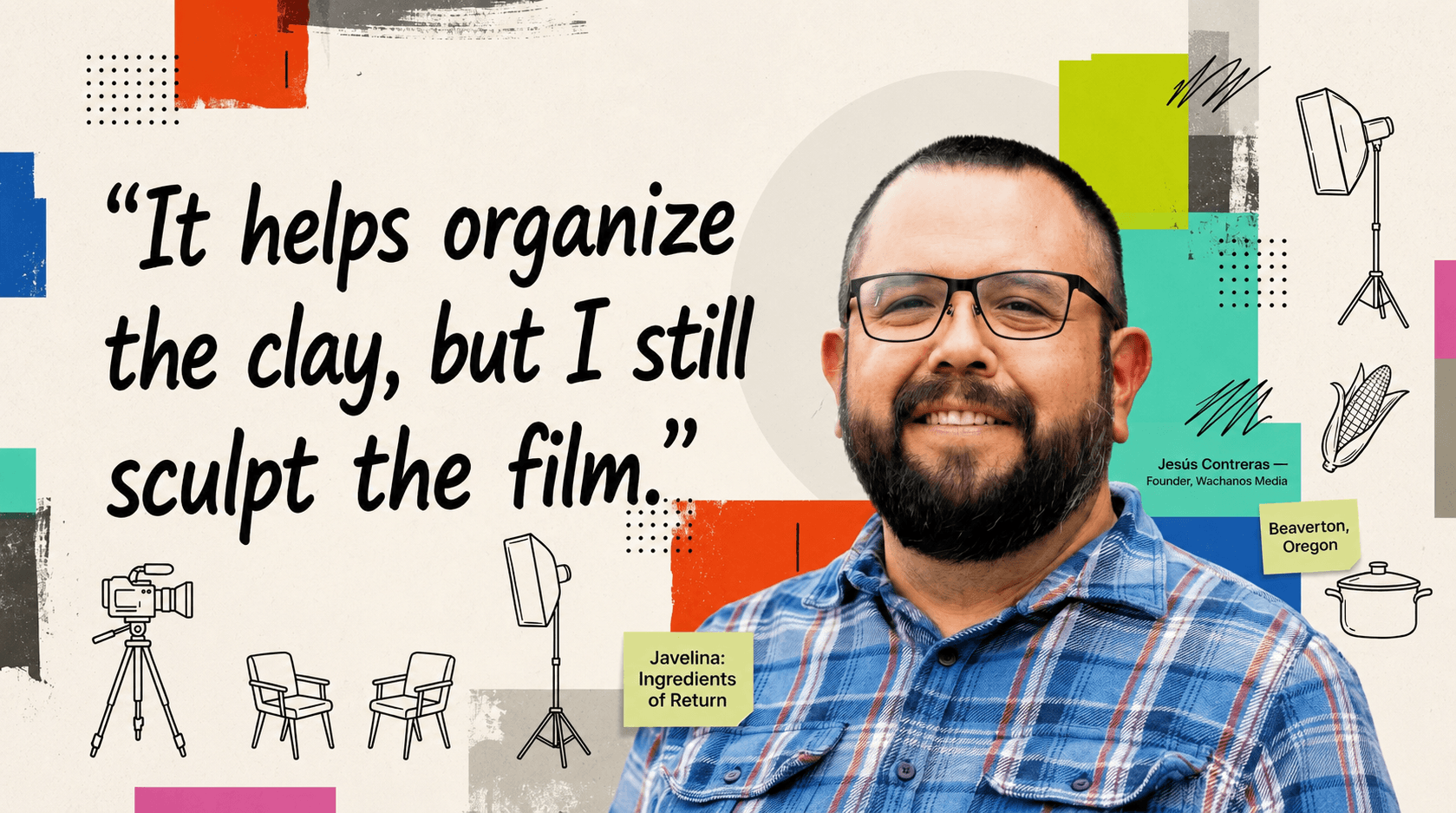
He is careful about where the help ends. Eddie is good at organizing interview material and surfacing useful moments, he says, but it does not replace the editor. The pacing, the tone, the emotional arc, the visual rhythm, the final structure, all of that stays his. The metaphor he reaches for is the one that gives this piece its title: the tool organizes the clay, but he is still the one who sculpts the film.
What he is really after
Strip away the workflow and the software and you are back at the idea he started with. A chef reclaiming a history through food, a filmmaker reclaiming a story from the chaos of its own footage: both are acts of return, of patiently finding the living thing inside something tangled.
It is also the advice he would give another documentary editor. Use the new tools, but as an assistant, never a replacement: let them carry the load when you have a lot of interviews, then keep the part that was always yours. "The judgment, taste, and responsibility still have to come from the editor." The tools will keep changing. What Contreras is looking for, the spine, the truth, the thing worth carrying forward, does not.
About
Jesús Contreras is a documentary filmmaker, editor, and founder of Wachanos (Wachanos Media and its film arm, Wachanos Films), based in the Portland, Oregon area and working out of Los Angeles. Wachanos Media produces civic, non-profit, and promotional video, including for the City of Portland Bureau of Environmental Services and the Tualatin Soil and Water Conservation District; Wachanos Films makes short documentaries shown at festivals across the United States. His Javelina: Ingredients of Return profiles Indigenous chef Alexa Numkena-Anderson, founder of Portland's Native American restaurant Javelina, exploring how food carries memory, identity, land, and community. Find his work at wachanosfilms.com, on Vimeo, and Instagram @wachanosfilms.