Case Study
How Kendrick Dean Finds the Story in the Edit
Fahad AhmedJun 30, 2026
At a glance:
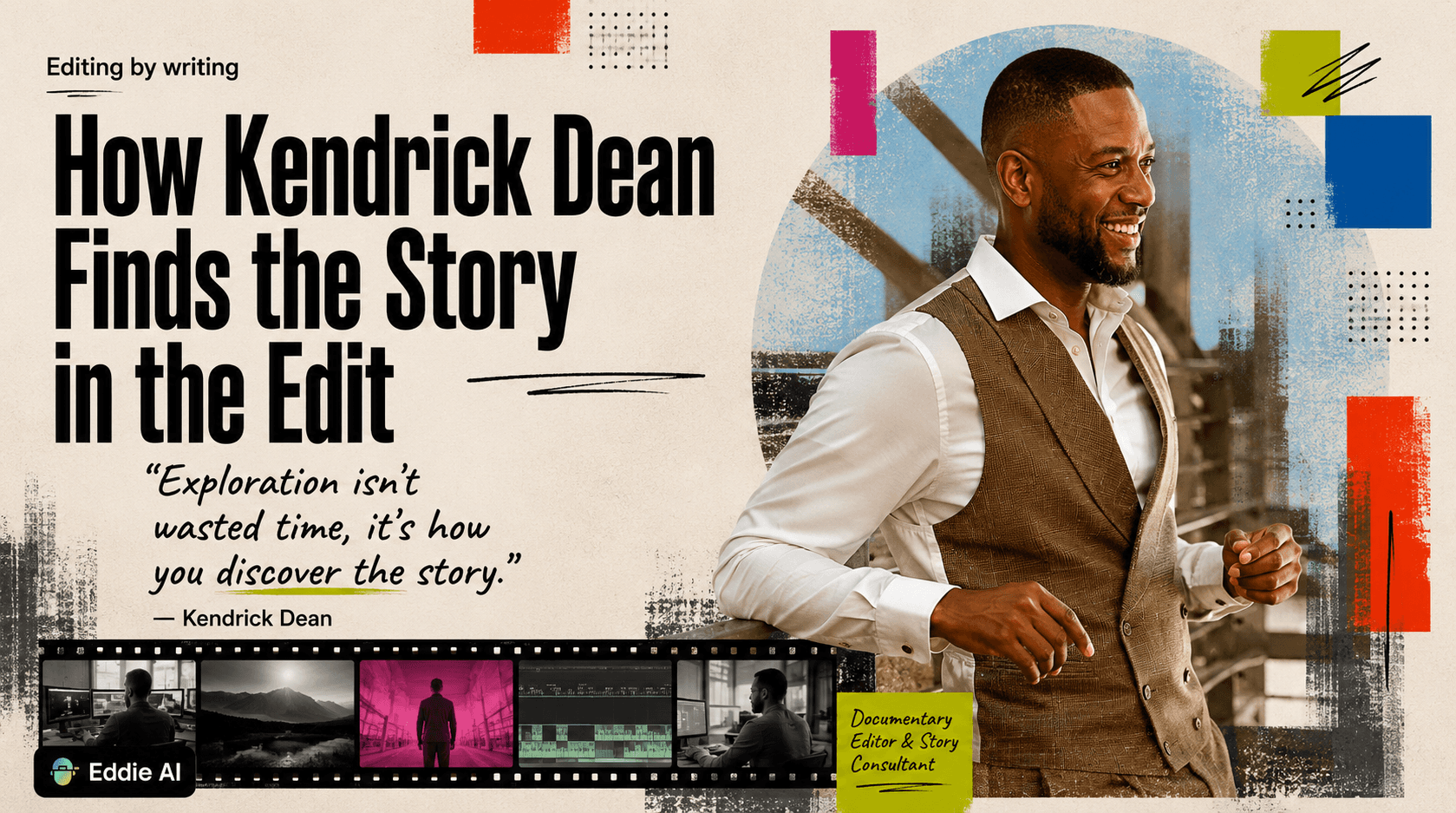
"Exploration isn't wasted time, it's how you discover the story." — Kendrick Dean
The hardest part isn't cutting, it's deciding what survives
Kendrick Dean has spent twenty years deciding what makes a record. As a Grammy-nominated producer and songwriter, known as Wyldcard, he has cut #1 singles for Chris Brown and Mariah Carey and worked with Destiny's Child, Usher, Trey Songz, and Mary J. Blige. His latest project is not a record. It is The Man the Island Made, his first documentary, about his father, whose character was shaped by growing up on Long Island in the Bahamas before he immigrated to the United States.
On the surface it is one man's story. Underneath, Kendrick says, it is about "how place, hardship, faith, and community shape a person's character, and how those experiences ripple through generations." He is making it now for a simple reason. His father turns 85 this year. "I realized there was an opportunity, and a responsibility, to preserve those stories while he's still here to tell them himself."
The footage reflects that ambition: long-form sit-down interviews with both parents, each running well over an hour, captured on two cameras, alongside archival photographs, family materials, and newly filmed B-roll. Dozens of meaningful stories end up competing for space in a single film. And that, not the cutting, is the real problem.
"The hardest part isn't cutting footage, it's deciding what deserves to survive the cut. Before you can think about pacing or visuals, you first have to discover the story's emotional spine buried within hours of conversation."
Eddie in the discovery phase
That discovery work is exactly where Kendrick puts Eddie. Before he opens his NLE, he uses it to log the interviews, organize the themes, generate different story structures, and build several first-pass assemblies to react to.
What he did not expect was how it would feel to work with. "Eddie feels less like a one-shot generative AI tool and more like an iterative editorial collaborator," he says. As he refined his prompts and gave feedback, it kept reshaping the edit while remembering the context of earlier conversations. In his words, "that's not just generative AI, it's iterative editing."
The payoff lands in the earliest, heaviest stage. Normally that stage is days of watching interviews on repeat, dropping markers, logging themes, building selects, and trying one structure after another. Eddie compresses much of that into minutes, and changes where he starts from.
"Instead of starting with a blank timeline, I start with several thoughtful assemblies that I can compare, critique, and refine."
What Eddie doesn't do, and that's the point
Eddie hands Kendrick a structural starting point. It does not author the film. Once he has a strong structural edit, he moves into Final Cut Pro for the craft that has to stay his: pacing, visual storytelling, music, B-roll, color, sound, and final polish. The judgment about which of his father's stories carry the film, and in what order they land, never leaves his hands.
Its real contribution, he came to realize, is not raw speed at all. It is room to think.
"Its biggest contribution isn't simply helping me edit faster, it's making editorial exploration much easier. I can explore multiple editorial directions quickly before committing to one."
The result
The stage that used to swallow the front of a documentary edit, the logging, the theme-hunting, the trial structures, now takes minutes instead of days, and Kendrick arrives at Final Cut Pro with several considered assemblies rather than a wall of raw interviews. Just as important, the mental overhead of "what if I organized the story differently" stops being a reason to avoid exploring. He can try the alternatives, because trying them is cheap now.
The Man the Island Made is [in production / status to confirm with Kendrick], a film built to preserve his father's story while he is still here to tell it. For a producer who made his name finding the right sound, the exploration that finds the right story has become part of how he works.
Try Eddie on your next documentary cut →
Drop your interviews in and let Eddie hand you a starting point. heyeddie.ai ↗