Case Study
How Innit Productions cut two episodes from eight days of footage with Eddie AI

Fahad Ahmed
·
How Innit Productions, a two-person documentary team, cut two episodes from eight days of footage on budget, with a veteran editor and a first-time editor both working the timeline in Eddie.

At a glance:
8 daysof raw footage cut into two episodes | 43 yearsof editing experience behind the cut | A- rollinterviews cut with Eddie as starting point |
COMPANY | Innit Productions — documentary production team working out of Europe |
WORK | Music-based documentary series, season two, distributed by American Stories |
ROLES | Stephen Eckelberry, editor (43 years) · Nicky Baker, interviewer & writer |
NLE | Premiere Pro |
USE CASE | A-roll interview cutting for long-form documentary |
“It doesn’t do the storytelling for you — it just gets you started. There’s an old saying: it’s easier to rewrite than to write. I find that true.”
— Stephen Eckelberry, editor, Innit Productions
The brief that didn’t pencil out
Stephen Eckelberry has been cutting for 43 years. He started on film, splicing on a Moviola, and has spent decades on feature documentaries and series work. Nicky Baker is his collaborator at Innit Productions — the team that shoots and interviews while Stephen handles the cut. Together they make music-based documentaries in Europe, with their second season distributed by American Stories.
On their latest project, the math didn’t work. An eight-day shoot. Two episodes commissioned. A budget that didn’t scale to the footage. Stephen took the job because he knew the filmmakers — but he could see what was coming.
“How the hell am I going to get through eight days of footage and two episodes without ending up paying to work? That’s where Eddie AI came in.”
— Stephen Eckelberry
Eddie as the assistant editor
Stephen didn’t use Eddie for everything. He skipped b-roll entirely — after 43 years, he can scan footage and find the shots he needs faster than any tool. The pain point was a-roll: hours and hours of interview footage that had to be cut down before any storytelling could begin.
He threw the interviews into Eddie and worked from what came back. For Stephen, the value wasn’t in Eddie making the cut — it was in Eddie giving him something to react to. He compared it to his early career on feature films, when teams of assistant editors would each take a pass: one specialist on dialogue, another on action. Each would hand him a cut. He’d look at it, say “no, that doesn’t work, this needs to come first,” and rearrange from there.
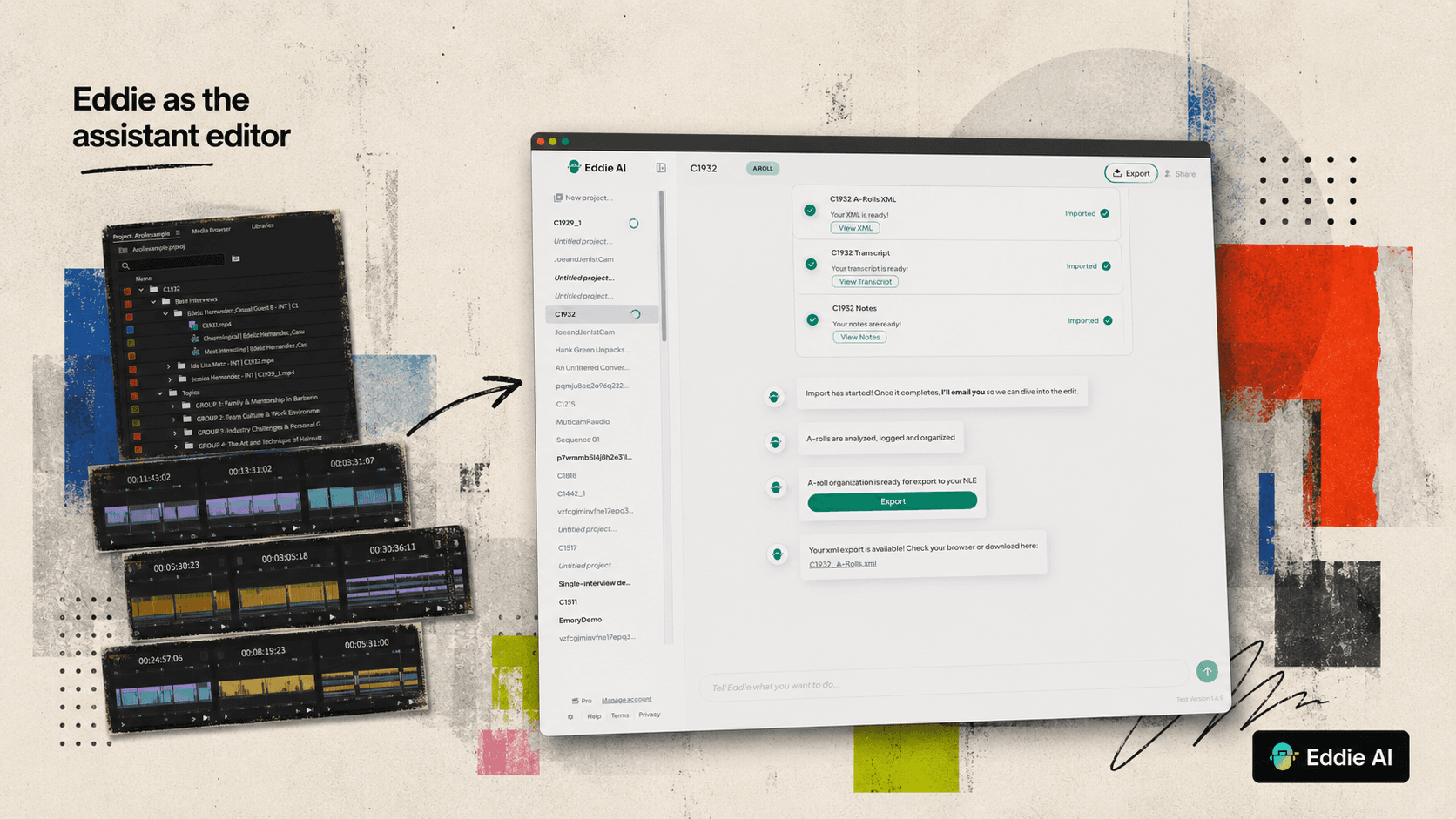
“Eddie does that kind of work. Then you look at it and go — no, that doesn’t work, you’ve got to do this first. But at least you’ve got something to start with.”
— Stephen Eckelberry
That reframe — Eddie as a junior editor on the team rather than a magic finish-button — is how a 43-year veteran ended up using the tool every day on this season.
Handing the timeline to a non-editor
On the second episode, Stephen tried something he’d never tried before: he handed Eddie to Nicky. Nicky is the team’s interviewer and a writer by background. She’d never opened Premiere Pro.
“I told her, just play with it and get it the way you want it,” Stephen says. She did. The footage went in, Eddie produced a starting cut, and Nicky shaped it from there — not by learning the NLE, but by working with Eddie the way she’d work with a writing tool.
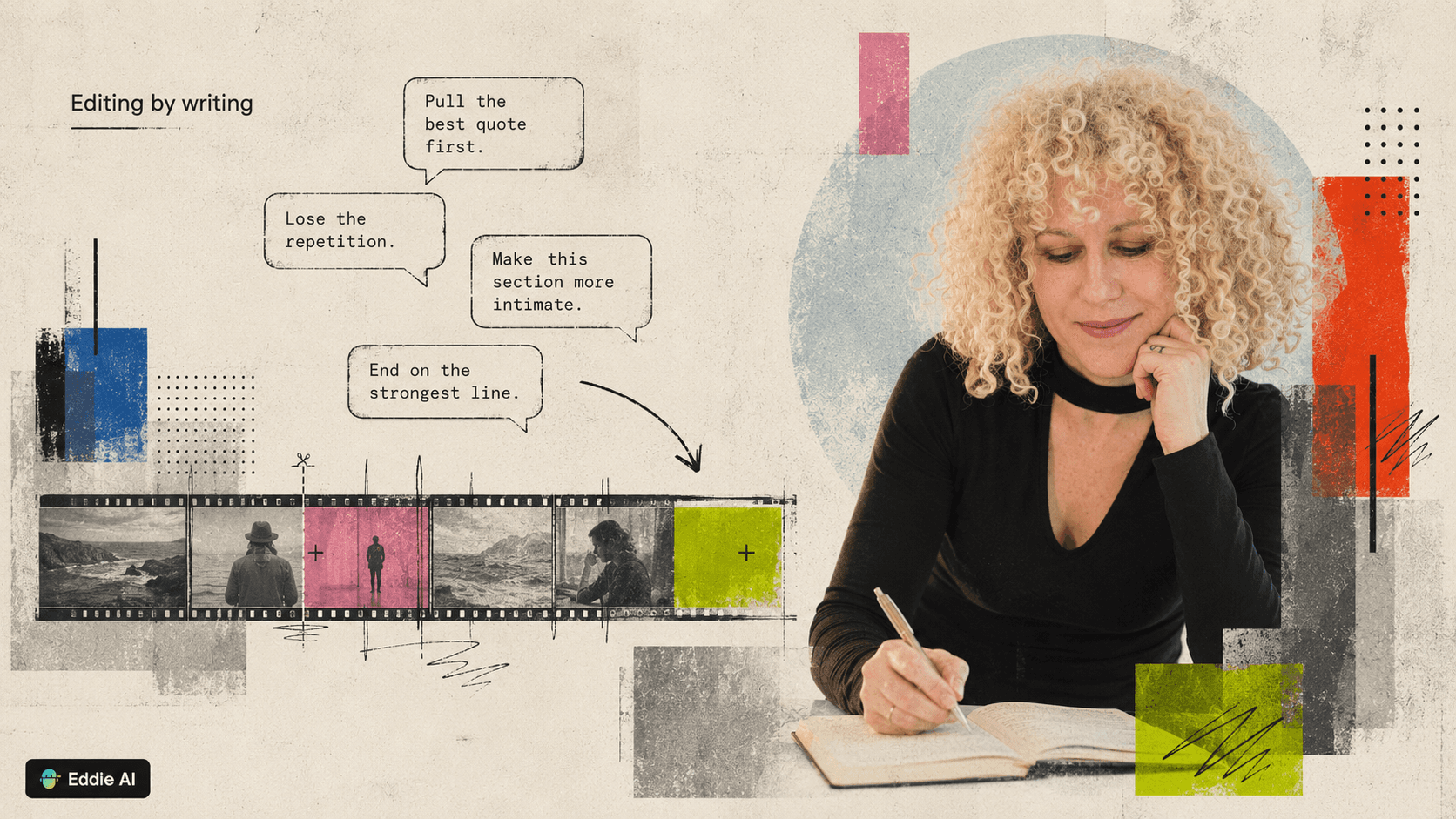
“As a writer, I found it very intuitive. With documentary, the timing is extremely important — and I found Eddie respected that. It got to the most important things.”
— Nicky Baker, Innit Productions
Nicky compared the experience to using ChatGPT, but with one critical difference: documentary editing has rhythm and timing that text tools can’t hold. “It’s very responsive to that,” she says. “I was learning more and more how to really hone in on what we needed.”
What Eddie doesn’t do — and that’s the point
Both Stephen and Nicky were specific about Eddie’s limits. AI doesn’t catch every emotional beat. There was a moment in one interview where the interviewer got visibly emotional — something that didn’t register in the transcript but mattered enormously for the cut. “You still have to do your homework and look at the footage,” Stephen says. “It doesn’t necessarily get the humor or the emotion of people’s faces.”
For Innit Productions, that’s a feature, not a bug. Stephen isn’t looking for an AI that pretends to be a documentary editor. He’s looking for one that hands him a defensible starting point so he can spend his time on the work only a 43-year editor can do — finding the emotional moments, fixing the order, making it a film.
The result
Two episodes, eight days of footage, a budget that started impossible. Cut on time. Cut without sacrificing the storytelling that Innit’s work depends on. And, in a first for Stephen, with his interviewer cutting alongside him.
Try Eddie on your next documentary cut →
In Summary
How Innit Productions, a two-person documentary team, cut two episodes from eight days of footage on budget, with a veteran editor and a first-time editor both working the timeline in Eddie.