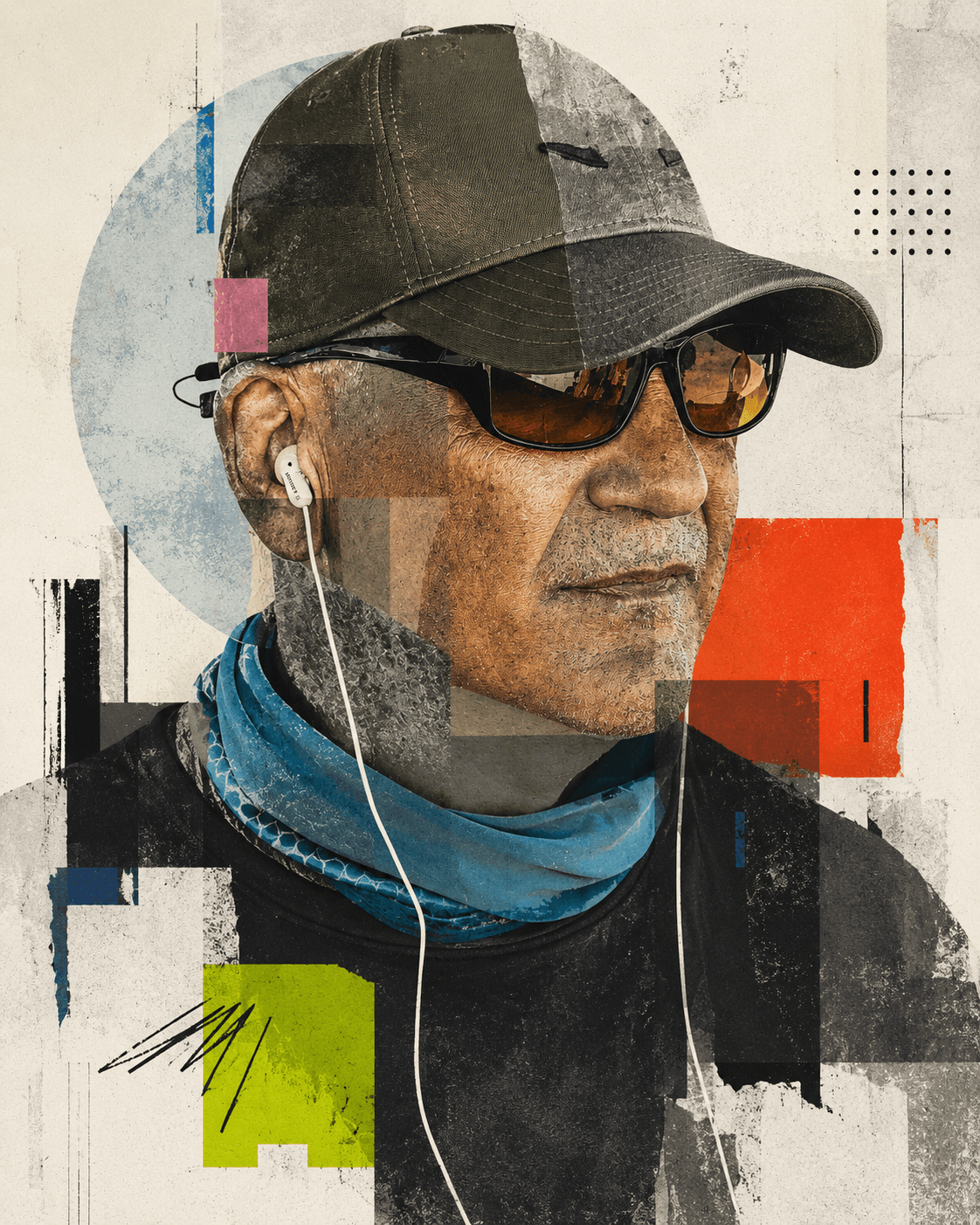
The Moviola was a machine you operated with your whole body. It stood upright like a sewing machine built for giants, and to find a single frame you fed the celluloid through by hand, working a foot pedal, listening to the film clatter past until your eye caught the exact moment you were looking for. Miss it, and you rolled back and went again. This is how Stephen Eckelberry learned to tell stories.
He was a teenager in Los Angeles when he started, having moved there at twelve from Brussels, where he was born. He got into the editing department at Paramount and worked his way up. The hours were long and the work was physical and he loved it completely. Somewhere in the clatter of that machine, a question lodged itself in him that has never quite left: out of all this footage, all these moments, which ones make the story?
The craft kept dying. He kept going.
He's been answering it ever since. More than thirty feature films and television series, most of them deep in the independent world. A horror film he produced that won Best Feature in Nuremberg. A wartime epic he co-produced that put Bruce Willis and Adrien Brody on US screens through Lionsgate. He directed too, his first short took the Golden Plaque at Chicago and screened from Cannes to Mill Valley. And in the spaces between films, more than two hundred movie trailers, those thirty-second stories that have to make you want the whole film, for Lionsgate, Warner Bros., and Disney.
But the number that matters most isn't credits. It's the number of times he's watched the ground move under the entire profession and kept his footing. The Moviola gave way to videotape. Tape gave way to digital. The flatbed gave way to the nonlinear timeline, where suddenly the film you used to hold in your hands was a string of pixels you could rearrange with a mouse. Each time, a generation of editors decided the craft was being ruined and quietly fell away. Stephen didn't. Every new tool, to him, has been just another way to get to the same old question faster. And the latest one would test that instinct harder than any before it.
What he was actually looking for
For most of his career, the work was narrative, scripted films, the occasional turn directing. He'd brushed against documentary here and there, including alongside Ondi Timoner, the only filmmaker to win the Sundance Grand Jury Prize for documentary twice. But it didn't fully claim him until a long-running unscripted series put him in the edit bay for dozens of episodes of real people, unrehearsed, unpredictable.
Something happened in those hours. A scripted film comes to you already knowing what it wants to be. Documentary doesn't. The story is hiding somewhere inside hundreds of hours of life as it actually happened, and the editor's job is to find it, the same question from the Moviola days, now with infinitely higher stakes and no script to point the way.
After forty years, that was the thing. Not the polish of a feature, but the search. He decided documentary was how he wanted to spend the rest of his career.
Farm Hero
Which is how he came to Farm Hero, a documentary series about regenerative agriculture, the farmers and ranchers fighting to bring dead soil back to life. The kind of subject he'd been looking for his whole life without quite knowing it: real people, real stakes, a story that has to be found rather than written. One season is rooted in the American West; the next reaches across the world to South Africa and Zimbabwe.
It's also made the way most documentaries are made, which is to say on a budget that doesn't quite add up. Two full episodes out of an eight-day shoot. Hours upon hours of interviews, all of which someone has to watch, and log, and carve down before the real work of shaping a story can even begin. For most of his career, that grind was done by a room full of junior editors. On a documentary budget, it's done by one person, at night, alone.
The part that has nothing to do with storytelling
This is the part of the job that has nothing to do with storytelling and everything to do with survival.
So he did something that would have been unimaginable on the Moviola. He fed all the interviews to an AI assistant editor called Eddie and let it do the first brutal pass, the logging, the sorting, the rough assembly, the work he used to hand to assistants.
He's unsentimental about what it is. "It doesn't do the storytelling for you," he says. "It just gets you started. It's easier to rewrite than to write." It won't catch the joke in someone's eyes or the grief behind a pause, that's still his job, and he says plainly it always will be. "But I sat down on a Monday morning and the work that used to take me a week was already waiting for me. I just got to start with the story."
For a man who once shuttled celluloid by hand to find a single frame, it was just the newest answer to the oldest problem: getting faster to the moment that matters.
The proof wasn't even his
But the most telling part of the whole experiment isn't even his. On the second episode of Farm Hero, he handed the work to his partner, the writer Nicky Baker, who will tell you cheerfully that she has no idea how to use professional editing software. She shaped the cut anyway, through plain language, the way a writer thinks.
"I'm not an editor," she says. "But as a writer, I found it very intuitive. With documentary, you need the timing, and I found the most important things came through."
A storyteller with no technical training, reaching the timeline directly. Forty years ago that would have been science fiction. To Stephen, it's just the latest proof that the craft keeps opening its doors wider.
Still going
He and Nicky aren't slowing down. They're in post-production now on a documentary about the European music composer Jean Kluger, a project that carried Stephen back to Brussels, the city he was born in, where this whole thing started.
About
Stephen Eckelberry is a film editor, director, and producer with more than four decades in the industry, now focused on documentary work. He runs Good & Plenty Pictures and edits and directs for American Stories Entertainment. Nicky Baker is a writer and voice artist and his frequent collaborator.
Good & Plenty Pictures ↗ · Watch Farm Hero ↗· nickybaker.com ↗